|
 |
Culture: Egonomics
rant warning Adam Smith, in his foundation-laying book The Wealth of Nations (1776) provided capitalism with its moral underpinnings – its justification. According to him, the wealth (and therefore wellbeing) of the (human) world would be enhanced if people were simply allowed to follow their ‘enlightened self-interest’.
The values of free trade and the argument of ‘comparative advantage’ were used by Britain to justify the invasion, conquest and control of more and more of the earth – land, human livelihoods, forests, minerals, fish and animals – in the name of ‘more must be better’.
(It is only recently that I have heard of Smith's earlier work, The Theory of Moral Sentiments, 1759, in which he writes about the 'inner man' who stands aside from our actions and judges them, free of self-interest.) Personal HistoryHaving grown up in the 60s and early 70s, in a youth movement/ pop music atmosphere of critical disaffection from the mainstream (partly hippy-flower power, partly left-wing) I’ve never taken capitalism’s rationales, or dress code, very seriously. It has always seemed clear to me, since I've been able to think about these things, that our economic system benefits a minority at the expense of the majority, both within nations and internationally.
My gut-level sense of this was only strengthened by two years in the USA, followed by six years in Africa. It is not easy to argue with a globally secured status quo (the international financial and economic system) – and yet the recent financial crash has opened the whole area up to more fresh air, and fresh vision, than has been possible up till now. But the point of this preamble is to admit that it is only very recently that I have (I think) begun to grasp the way economists think about growth, and about capitalism – and to explain why it has taken me this long. A Brief History of Capitalism
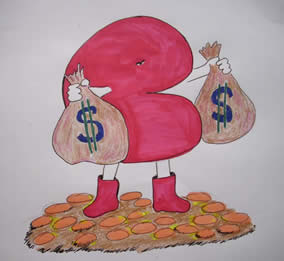
Hobby Horse Alert! The wealth that industrialisation has enabled a minority to amass and ‘save’ – or re-invest in the capitalist system – is used to fuel the next round of ‘improvements’, ‘progress’. This is a self-perpetuating process by which people’s ‘self-interest’ keeps the economic wheels grinding, and 'guarantees' ever more ‘growth’.
As a vision of the future, seen for the first time, it must have been very exciting – and subsequent events have certainly borne out Adam Smith’s confident theories.
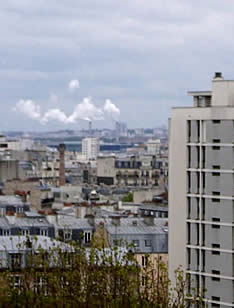
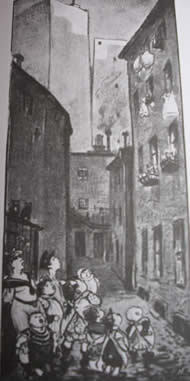
Paris cityscape, 2011 The economic system - trading and industrialisation - that has evolved since the late 18th Century generates products for sale, and jobs that pay wages. By and large, these outcomes are hailed as good things. But the process of 'economic development' has had, at best, a mixed impact on the lives led by so-called ‘pre’- industrial peoples, who are often insultingly described by Western commentators as ‘scraping a living from the land’.
Zimbabwe homestead, 2011
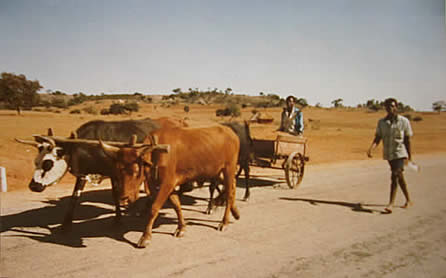
two friends with oxcart, Zimbabwe c 1986 Post Crash (Temporary?) WisdomIn the wake of the current financial meltdown in the West, and the emerging revelations of things we already sort of knew - that banks were gambling and speculating, and everyone was being incited to borrow beyond their means - there has been much shaking of heads and reference to 'casino capitalism'. Some commentators (though not most) have admitted that this latest 'bust' is bigger and less reversible than previous ones - I would say, primarily because we are pushing at the limits of the earth's capacity to accommodate our ever-expanding affluence. However, this is not a problem of the past ten or fifteen years only. Financial wheeling and dealing are part and parcel of the whole 'free market' set up. It is just not true to claim that only recently have our banks and financial regulators fallen short of an otherwise viable model for increasing global wellbeing. A Longer ViewWhen we look at the nature of the initial wealth accumulation that underlies the West's current global dominion – the original establishment of ‘comparative advantage’ – whereby some became manufacturing nations and others exporters of ‘natural resources’ or ‘cash crops’ – the distasteful heart of the whole economic process is revealed.
Conquest (by military invasion, but also very often by commercial-political sleight of hand – lying, cheating, treaty-breaking; and usually after a period of sanctioned 'softening up' by missionaries) was often followed by slavery, and/or genocides both deliberate and unintended, and by the privatisation of whole continents in Western European hands. Many Westerners still have not owned up to the basic truth about what we (or our ancestors, whose ill-gotten gains we have inherited) have been up to, around the world. We are in no position to preach to other cultures about correct behaviour! There is a heavy irony in the West's moral complacency and obliviousness, and our self-image as being 'more developed' and 'modern', while we refuse to acknowledge the darker underside of our dominance. The very concept of land ownership, together with rest of our advantage-establishing activity, was based in disrespect, coercion and violence - much of it irreversible and terminal - towards other peoples in their own countries. The Bottom LineIts underlying, inhumane premise and nature has meant that capitalism and the industrialising process have not, I believe, promoted the good of the majority. For the economic view of life that drives our capitalist system sees people as cogs in the economic machinery.
According to this view, human beings, like minerals and water, trees, animals and everything on the earth, are to be used as means to an end – the end of profit, and so-called ‘growth’.
(Hence the unpleasant, revealing phrase, 'human resources'.)
This economic pseudo-growth is taken as the highest ‘good’, which must be nurtured and tended, trumping all other values. In the Middle Ages in Europe (and in feudal China, for example), the parallel value that trumped all others would have been the‘divine right’ of kings,
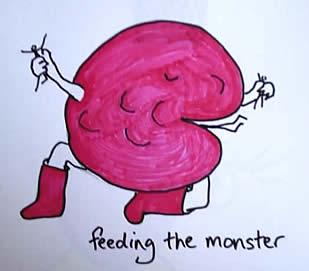
a 'value' which was also designed to justify the status quo of ‘might is right’, and to gloss over its morally questionable history and tactics. It is assumed, and often asserted as a 'fact' of economic life, that all this profit-chasing benefits people, by ‘producing’ ‘more’. Those at the top certainly gain advantages - more material security and comfort, longer lives, endless travel opportunities. And most of us are reluctant to interrogate the system, or pay close attention to how, and at what real-life cost, these profits are generated. We prefer to close our eyes and let the market work its magic (ego the conjurer).
In spite of the recent financial crash, we still dare not stop believing in our modern god of ‘economic growth’. This is our new religion. But we in the UK and USA are running on empty, and on worse than empty, we are running on a money-printing bubble of 'quantitative easing' - though, thanks to this latest wheeze, we haven’t yet (as of October 2013) felt the truth of our situation. An Old AttitudeAs I keep saying (!), our ‘modern’, Western-dominated global economic system, since it got going several centuries ago, has been built on expropriating – taking – feeding on – and burning up, what we ourselves – and not just humanity - are part of.
But here's a thought: whatever our myths and religions may have told us: humanity is not the centrepiece of creation. We did not create the earth, or its life, and we do not manage it. It is not under our supervision. We overstep our proper limits, and make ourselves strangers to reality, when we treat the earth and one another as if it were ours to rule over, control and 'improve'. The very ethos of our economic system - the world view which assumes our right to treat people and creatures and 'things' as we like - has grown out of our religiously sanctioned arrogance, and blinkers us against the truth of our position. We are encouraged, in Western culture, to set ourselves above and against nature - in the name of 'progress'. In the name of progress, and a better life, we are destroying the earth, our only home.song: Only One World Predatory Ego-nomics
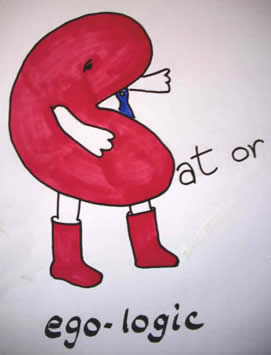
I sense a connection between the heroic self-image of Western-initiated capitalism, and ego’s self-presentation within the psyche. Ever eager to 'help', ego steps forward as fixer, strategist, hero and champion.
In fact, ego comes into being within the psyche as our inner protector from harm (our knight in shining armour) - because, due to some inner injury or pressure coming from the world around us, we have come to feel inadequate as we are, and in need of armoured defence. And just as liberators and champions often go on to become corrupted and power-hungry despots,
ego within the psyche becomes a predatory parasite on life which undermines our wellbeing, and twists our thinking, stirring up conflict and self-conflict, and perpetuating inner unease and discontent.
The parallels between ego's doublespeak and destructiveness within the psyche and the way we allow our economics (or egonomics) to rule our priorities and behaviour are evident, if we are willing to see them. Things are ChangingAt present, the global process of economic ‘growth’ is entering a new phase. We in the West are beginning to sense our ousting from prime power position on top of the world. And how quick we are to criticise China for its ‘imperialist’ agenda in Africa!
The things we can’t stand about other people are often the very things we can’t bear to acknowledge in ourselves: likewise, the predatory, profit-oriented behaviour of other, 'rising' nations arouses our disapproval, now we are no longer the main beneficiaries. Not having a leg to stand on doesn’t hold us back. It never has. A case in point: British righteousness about slavery was instantly and shamelessly present, the moment Parliament agreed – after decades of resistance, and for largely economic reasons – to abolish the transatlantic slave trade we’d set up and pursued with such dehumanising zeal. Our sudden recovery of moral scruples was enforced on other nations by British naval patrols, crewed by pressganged men who were treated little better than slaves, with the anthem ringing that 'Britons never, never, never shall be slaves!' We are still deaf to the ironies of our moral posturing, and find it convenient to forget that we British have continued to profit, more than any other nation on earth, from the proceeds of that long-lasting crime against humanity. (See The Myth of Progress.) Airy AffluenceOur consumerist lifestyle and culture are often referred to as ‘materialistic’, and yet what is driving humanity's accelerating global rush into a future of 'more economic growth equals a better life' is not so much the desire for material goodies, or even conveniences and services, as a belief system, a cultural construct that originated in post-reformation Europe. Industrialising Western culture has built a city in the clouds, to which everyone has been encouraged to aspire.
And even if we see – as we are just beginning to - how untenable the whole thing is, given the detrimental impact of our behaviour on every aspect of the earth we study, it’s not easy to alter our course, and not easy to think clearly about something so bound up with our history.
But life goes on, and there is more to life (thank God) than what any of us can see. Our attitudes are changing. It seems to me that the recent - and continuing - economic shock we are undergoing is combining with other areas of dawning insight – about our misuse of the earth, for example, and our attitudes to other peoples and cultures – to help us towards a more realistic grasp of who and how we are, and just how we Westerners have got into this situation.
|
home | intro | fear | egoland | miscellaneous | the heartland | writing reflections | psyche | culture | on the way | sentences | wordplay |
|
updated 19/2/12 |
|