|
 |
Fear-Based Entertainment
Many novels, films and computer games are driven by violence (physical and emotional), or by the threat of violence. Deep down, therefore, their appeal is based on arousing, and playing with, our fears. In physiological terms, this fear arousal is not so different from the thrill of extreme sports – or extreme sex. I don’t want to start speculating about why otherwise kind and decent people are not repelled by this sort of ‘recreation’, and may even be attracted to it. However, I do want to suggest that arousing fear is not, in itself, helpful. Speaking personally, I have my hands full, just maintaining enough inner tranquillity to be able to feel and acknowledge my own fears, without panicking! Keeping my equilibrium amid the twirling or lurching events of every day is exciting and challenging enough, in my experience, without conjuring up fresh fantasies to stoke my fear furnaces!
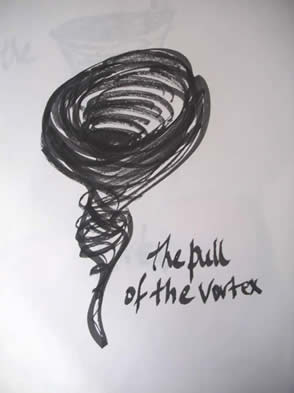
Fear is destructive of love, humour and enjoyment, it can paralyse and torment us. Fear is what drives people to self-betrayal, and to all kinds of reckless inner and outer behaviour. If a story evokes fears in order to let us see further into how fear works on us like acid on our feelings, then insight may calm and help us to release these fears - or it may not. But a great deal of fear-based entertainment is made cynically, and for profit. Fear, after all, is very profitable for many economic sectors, from the military and security industries, through insurance to pharmaceuticals and entertainment. Even education – meaning (besides the torture of exams themselves) parents’ anxious pressure on their children to perform well and get on, in case they get left behind in the race for survival and respect – is not untainted by fear. The Attraction of Fear Fear attracts in an addictive way, like adrenaline – like the lure of the vortex. It has aspects of both carrot and stick, in its threat - or titillating promise (hidden or explicit) of ‘something awful’ to be witnessed.
There are also gifted, even brilliant writers, painters, and film-makers – who are not cynical about their work, and yet who are content to mine their own unconscious for violent and fear-arousing images and stories, and who have little or no insight into the origins, or effects (on themselves and on others) of the fears they arouse. This feels to me irresponsible, and even sometimes exploitative. UnsafetyUnsafety is what excites many contemporary artists, filmmakers, and writers. Their aim is to unsettle, disturb their audience or readership, and one of the favoured adjectives critics use to describe such work is 'dark'. There is clearly much going on in the world around us which requires uncovering, much violence and abuse that is still overlooked, and abusive practices that hide under cloaks of 'normality' or 'economic development', as well as 'security'. We do need to have our unthinking acceptance of the unacceptable challenged, our received ideas questioned.
However, I often have the sense that, in evoking unsafety (as for example Ian McKellan does in Saturday, or Annie Proulx in Accordion Crimes, or as Ian Banks did in The Wasp Factory - or Anthony Burgess in Clockwork Orange, or William Golding in Lord of the Flies) - the subtext is that unsafety is our true condition in this world. (I omitted the word 'existential', as it is both loaded and redundant, in this context.) According to the world view that informs these works, the true face of human life, normally hidden by a facade of cosiness or 'civilisation', by denial or by exploitative power relations - is a yawning abyss of cruelty, meaninglessness and random violence.
I would suggest that this 'abyss' is actually a creation of our 'modern' fears - the same fears which these productions arouse and exploit. I believe our Western culture is presently caught in a cleft stick of complacency and despair. We believe ourselves intellectually on top of the world, the 'best culture yet', above religion - or at least, above other people's belief systems - yet what we are proudly building is a motorway off the earth.
I believe the hidden realities which are obscured by our everyday assumptions are very different: firstly, the existence of natural justice; secondly, the essential equality - by which I mean the equal value, not the sameness - of all people. Thirdly, correct and respectful relations between humanity and the rest of the earth and its creatures.
Because of the nihilism at the heart of much of our culture's most celebrated work, these creations often feed our fears, and therefore heighten our self-protective reactions. That is, they fuel ego and its strategies for 'keeping us safe' in the teeth of a 'hostile universe'.
But life itself is not unkind, though it can be challenging. People can certainly be unkind - and are usually oblivious to their own unkindness. If we can stop slandering life, and learn to hear the tone of voice in our own minds, then we can begin to become more humble, realistic - and more humorous - about our place in the world.
|
home | intro | fear | egoland | miscellaneous | the heartland | writing reflections | psyche | culture | on the way | sentences | wordplay |
|
updated 11/02/12 |
|