Introductory Thoughts
I
These Rough Guides to the Heartland describe how I have learned to recognize my inner signals, and think more clearly about my feelings. I am also writing them to acknowledge and validate the zig-zagging routes life leads us along, the difficulties we encounter, and our honest efforts to deal with tricky situations correctly.
I would like these Guides to encourage readers to laugh (or at least smile) at the nonsense we often find going on, both within and around us, so we can feel more detached from ego-based pressures, and more at home in our hearts and in our lives.
It has helped me to learn, slowly, not to look away from my feelings, however uncomfortable it is to attend to them. By not overlooking my responses to people and momentary situations, I have found guidance, a sense of inner companionship, and release from my fears. My feelings have proved reliable friends.
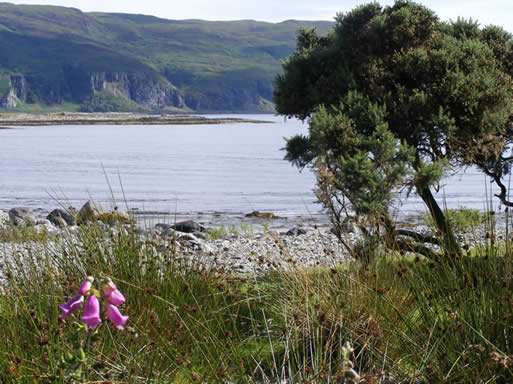
The Rough Guides title suggests getting to know my inner terrain, and to feel more at home here – to come to recognize its bumpy places, its ravines, its wide open spaces and flower-filled meadows, its rivers and its mountains.
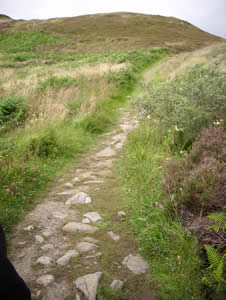
. . . on the way . . .
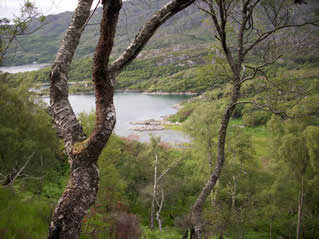
glimpsing something
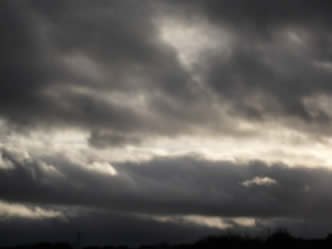
. . . a threatening sky . . .
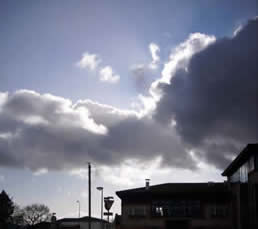 or a dramatic one . . . or a dramatic one . . .
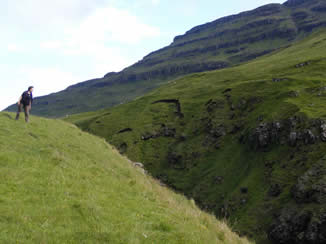
staring into a chasm . . .
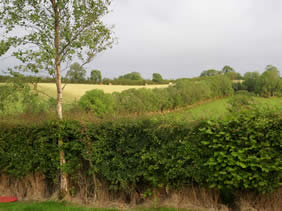
or contemplating order and plenty . . .
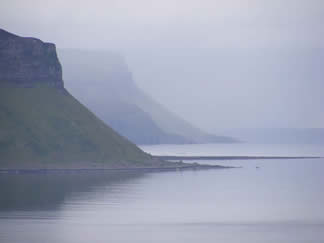
. . . dreaming, gazing, into shifting distances . . .
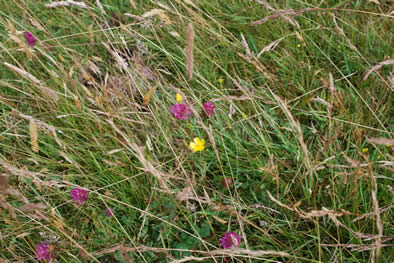
or up close, in detail and wonder . . .
These are metaphors for different ways I have felt, at different moments and in different situations – but my inner terrain, however rocky, is where I live - it is mine, and getting to know it has transformed the way I feel about it.
II
Each moment in life is full of potential – and it is up to me how I respond to events: I can turn away or turn towards them, I can choose to let them float me on downstream, or I can do battle with them, I can savour them (sometimes), or I may try and spit something out, pretend it’s not happening.
I can go down into difficult feelings and situations, and let them teach me their lessons in the depths; or I can grit my teeth and carry on. Or I can let an unexpected event inspire me to say or do or make something I hadn’t even imagined before.
On different occasions I have done (and still do) all of these things.

Every moment of life belongs to eternity, to reality. When I am in harmony with my heart, I find myself in tune with life. At these moments I feel myself participating in reality - in what endures, is real, is trustworthy, and no fantasy.
Living like this is what I call living in the Heartland – relating to how things actually are, to what works, what really is, and not to what just pretends to be. There is an awful lot of just pretending in our culture, and it matters – it makes all the difference – to learn to distinguish between truth* and pretence, and learn to stop catering to what’s not real – what’s based on fantasies, falsehoods and fear.
Our own spontaneously arising feelings are our true and individual connection to reality - to what is and works and is no lie.
I have learned from experience that the validation for attending to my feelings and being true to myself – to reality – is felt immediately, in my body, which feels strengthened and relaxed, making me feel more alive, light and open.
*I do not often use the word ‘truth’, in these Rough Guides, as it has become embroiled in abstract arguments (which ego just loves). In this paragraph, I am using the word 'truth' to refer to what is trustworthy.
(This footnote also gives me the chance to draw attention to the evasive, diversionary, untrustworthy tactics of the ego-driven intellect.)
III
Life, as we all know, is not always straightforward or above board. Or, more accurately: human dealings are not always straightforward or above board. There are dangers and dark places we can get caught up in, and what’s going on under the surface is usually the decisive thing in our interactions with others. What makes relationships wholesome and enjoyable, or confusing and draining, lies on the inside, not on the surface.
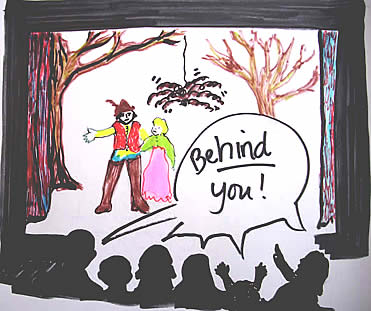
The Christmas pantomime cry of ‘It’s behind you!’ can be true at any time of year. What matters, and what makes all the difference, is often precisely what I don’t see – what I can’t see– in my own attitude and/or behaviour - because it's unconscious.
Things don't become unconscious for no reason. There's always sufficient cause for some feeling to have been consigned to a locked box in the psyche that I 'don't know about'.
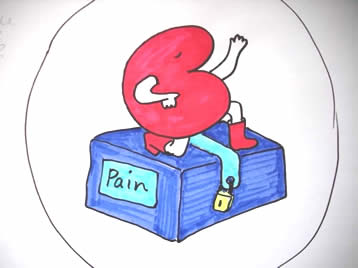
And whenever some unconscious material resurfaces in my mind (as it does from time to time, thank goodness), I am always astonished: not by its unfamiliarity, but by its intimate familiarity to me. How could I have 'not known' - i.e. been genuinely unaware of - this basic, utterly known experience?
Ironically, it is the problems I remain unaware of that stand in my way, and may lead me into cul de sacs and repeating patterns of trouble. The problems I am aware of can be slowly dissolved, dealt with – transformed.
Heaven and hell are real human conditions - i.e. states of mind. I would say that we are in hell when, by banishing our own knowledge into unconsciousness, we have let our minds become separated from reality, when we set ourselves ‘above’ or ‘against’ life, in whatever ways, and for whatever reasons we do this.

Many things can cause such separation – lack of love, or twisted love, in infancy – intellectual arrogance (which may be in compensation for a lack of love) – believing in hero myths and fear-generating fairy stories are just a few. I could add fear of being excluded from ‘the gang’, and fear in all its forms.
Our contemporary news and entertainment industries are largely designed to keep us anxious and on guard (shock – outrage – blame – attack - boom! bang! and gruesome detail – intrusion – voyeuristic thrill and revulsion) although at the same time, our media also tend to soothe, flatter and distract us from the real dangers of our way of life, financial, emotional and ecological!
Instead of threatening our children with bogey men or evil spirits, now we teach them about ‘stranger danger’. This is unwise, for fear is the surest way to attract danger, including predatory behaviour and bullying, at any age.
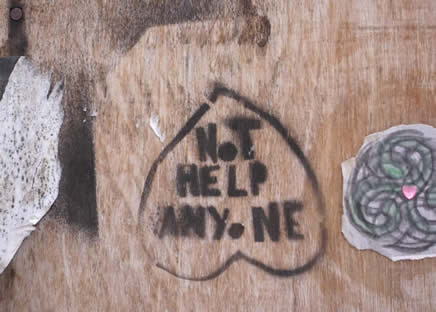
A healthier path is also being followed now in schools, however, in teaching children to listen to their feelings, and trust them. Which brings us back to the Heartland, and heaven!
IV
The Rough Guides to the Heartland could have a subtitle: My Road Back to Myself – except that this suggests autobiography, which this isn’t. So, more accurately, it might be subtitled: Some Discoveries Made on my Long Journey Back to Myself from a Place of Self-Estrangement. Which makes it all sound quite eighteenth century, but that’s OK.
Another useful subtitle could be: Growing True to Myself. (Or Yourself.) This phrase suggests roots reaching down, an upright plant or tree, energy flowing naturally – a beautiful, calm process.
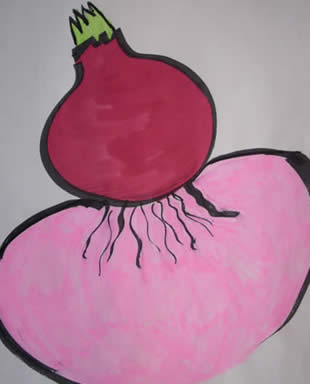
And this phrase also suggests that such growing (true to myself/yourself) is what reconnects me/us, more and more fully and reliably, with other people and creatures, and with the natural world, up to and including the Cosmos.
These may sound like wild claims or fantasies – but the fact is, just as we can become separated from ourselves, from our own feelings and our own will, so too we can become reunited with ourselves.
I believe that whether or not we do become (or remain) true to ourselves makes all the difference to our lives, both to how we experience life (as enjoyable and fulfilling, or frustrating and painful) and to the effects we have on those around us and on the wider world we share with others.
N.B. I'm not suggesting that becoming reunited with ourselves is a simple, clear, once-and-for-all act that means we will never again have to go round another turn of the spiral and find our way back to ourselves once again. Life seems to go on and on requiring courage and discernment, and confounding our expectations - often in wonderful ways.
V
There is an equation implicit in these Rough Guides to the Heartland. It is that the Heartland equals Reality equals the Cosmos equals Nature, including our own human nature, equals harmony and connectedness.
Egoland, by contrast, is a construct – a fiction. It is like a hall of distorting mirrors.
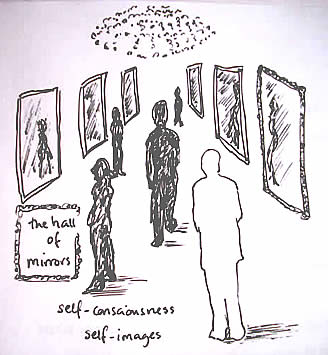
Deception and self-deception - reliance on self-image, conflict and strategy - power games, and all forms of meanness and insensitivity are based in self-estrangement, self-betrayal and fantasy. The very existence of ego depends on our accepting as true falsehoods and slanders on life.
Ego derives its emotional grip and force from the fear – the fear aroused in us by its lies. Ego turns this fear around and directs it at our own feelings – threatening us with humiliation, condemnation and abandonment, if we open our hearts to feel our own feelings.
Learning to spot and stop such ego reversal is one of the most helpful things we can do, to free ourselves from ego’s twisted scenarios and misleading nightmare versions of things.
And yet, although this is easy enough to describe, and to grasp mentally – knowing the truth about ego doesn't mean I will no longer be fooled or seduced by it. Even if I ‘get’ this account of life on the inside, and accept it as being accurate, my psyche is still susceptible to ego’s strategies and provocations, and to its insidious offers of ‘help’ (which are no such thing).
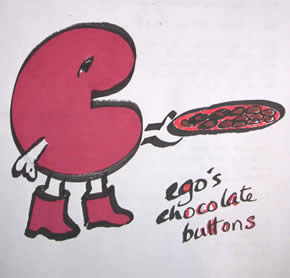
We have to find our way back to reality, and out of Egoland, over and over again (on the spiral path). I can still be unnerved – frightened back into reliance on my ever-ready ego, into listening to its destructive counsel and abandoning myself, when I feel under pressure, by accepting its ‘protection’.
We need to forgive ourselves for these lapses – as Carol Anthony says, in her Guide to the I Ching, ‘misunderstanding is the necessary prelude to understanding’. And we need to remember to ask for help, when we notice we have slid, once again, into a slimy or a murky state of mind.
Resisting ego’s approaches – spotting and stopping them – helps us develop self-awareness, and a sense of humour about our own inner shenanigans. We have to practise what we know.
|