|
|
A rough guide to the Rough Guides
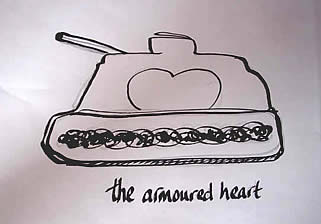
The journey to the Heartland I am describing here – by which I mean the journey back to my own inner truth – has been made by noticing and attending to my feelings, and thereby dismantling the protective barricades I had constructed around my heart. I expect that most of us do build some kind of fortifications - or allow them to be built (by ego) - to help us cope with pain and difficulty perhaps, to project a confident self-image when we are actually in distress, or to avoid disappointment by being negative first!
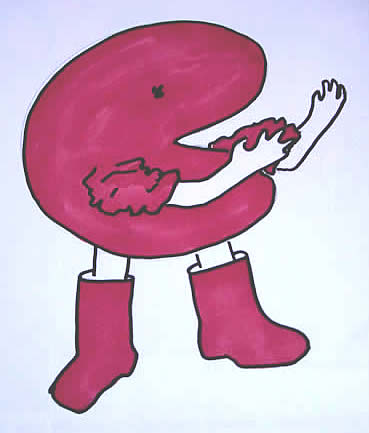
introducing eager ego - here to help
Also, as children, we can't help taking on board many falsehoods and half-truths which our culture has accepted at some time, and passes on as ‘truths’ to each new generation. Once we commit ourselves to finding our own way, events themselves become our helpers – often events that feel anything but helpful at the time. On our way to the Heartland, life itself is our guide.Through observing my own experience, I have noticed that life and the psyche work hand in hand. When something is wrong in my feelings, I unconsciously bring about (or walk into) situations which exactly match (and thereby bring to light) my own misguided state of mind. In the past, this tended to involve some crisis, or conflict, or long-drawn-out 'mess'; these days, it's more likely to feel like a dilemma or a discomfort - an area of unclarity.
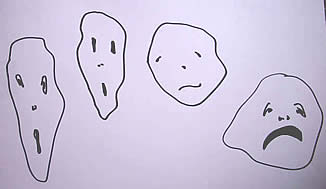
In the early stages of my inner journey, the false beliefs that were tripping me up (beliefs about myself, and about life) were so buried in my psyche - which, I believe, includes my body - and thus, so enmeshed in my whole way of being, that without some big smacking disaster that forced me to stop! look! and listen! - I would never have spotted anything wrong, much less begin to feel the fears these beliefs were arousing in me. By learning to recognise my fears, by feeling and acknowledging them, bearing them consciously and not sweeping them aside - and yet not allowing them to swamp me - I have slowly learned not to be driven by them. I have (nearly!) stopped being unconsciously intimidated by my own denied feelings. I can still be unseated, unsettled, of course - but now I notice, if not immediately, at least within a day or two, that something has 'got to me'. Then I know I have to keep taking the time to listen to what's going on inside me - to give my ruffled feelings a hearing, and a chance to calm down. The good news here is that I have been able to learn, gradually, not to let myself be bullied by my own fears. And so these days I am a bit less easily bounced off-track by others' mistakes and thoughtless omissions. song words can be found in Miscellaneous By going on with my life day to day, step by step, by dealing with each new situation that arises, I carry on getting to know myself better, and seeing deeper into my own heart. This helps me to spot the stowaways and troublemakers I am still giving houseroom to. |
|
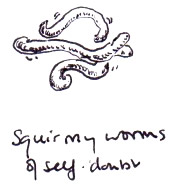
stowaways and troublemakers
As I have learned to steady up, and to curb my panicky reactions to other people’s ego-sponsored behaviour around me, any aggression initiated by someone else is freed to boomerang back to them, as it naturally does, if no one else takes the bait. Remaining steady and neutral also forces my own ego-tinged motives and unconscious nonsense out into the open, whenever I manage to focus on my own reactions to people’s insensitivity, or out-of-control behaviour. This helps me avoid allowing my ego to get all hot and bothered, and start a mental argument with them, or jumping in to set them right or have say - never a good idea. I can only hope that practising attentiveness to my feelings also prevents most of my own misbehaviour and insensitivity from getting out of hand before I catch on! The Inner TerrainThe word ‘rough’ in the Rough Guides of the title refers, among other things, to the rough inner terrain we often find ourselves on – the bumpy ground of shocks, challenges and tricky situations, of our own buried landmines and mine-shafts. (Mine, mine, mine!)
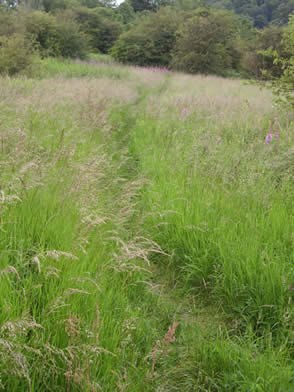
The roughness itself – the discomfort of being off the path - can be my guide, if I let it be, and keep noticing how it feels 'under foot': ‘not this way’ – ‘not like this’ – ‘this doesn’t feel good / right’ – ‘back to the path!’
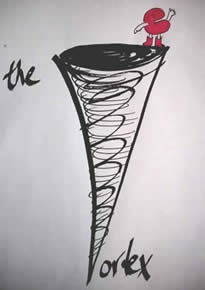
Until I began to become familiar with my feelings, and learned to accept them and be kinder to myself, it was all too easy for my ego to mislead me into panicky reactions, when I felt uncomfortable. Instead of stepping away from the warning sensations of ‘roughness’ underfoot, and coming back to myself, to my true path, I often (out of old habit) let ego draw me on into a vortex of self-conflict, fear and conflict with others, so that I lost my bearings and felt out of control, panicky.
For years, this is what used to happen to me, when I sensed something like a stone in my shoe, slippery rocks or scree underfoot. |
|
Ego's RoleI believe I can remember the moment when I 'discovered' that I could just pretend things weren't happening, and that I wasn't feeling upset by them. (It was in the back garden, and I think the sun was shining.) I remember it felt like a brilliant revelation - the end of distress and frustration, by the stroke of my own mind.
I now think this was a turning point, when at some level I dissociated from my own feelings, and which made it quite difficult for me, later in life, to get back in touch with them. I also think this inner act of mine issued a licence to my budding ego - persona - whatever we choose to call the web of strategies that children weave, to get by in life when they find themselves struggling. I was not alone. Many people (perhaps even most?) have made an unconscious deal with ego, accepting its promise that we’ll feel better if we can just stay ahead of the rest, control the situation, derive some emotional or material advantage from each interaction, or whatever script appeals to our character. Ego-ruled behaviour can range from mild to severe. It is hard to be around, and also self-frustrating for the one doing it. Some believe they have to get the better of everyone else, or ensure (or at least be sure) that someone else feels worse than them – or that they need to hook someone else in to feeling responsible for them. I certainly signed up to a few of ego's special deals, and found it very tricky, later on in adult life, to spot what was going on. (Also very embarrassing at first, when I began to!) It's much easier, of course, to spot ego in others.
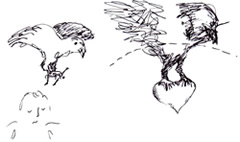
We can usually find some kind of ego intervention lurking behind disruptive behaviour patterns, be they intrusive, attention-seeking tactics, undermining tactics, and other attempts to unsettle others. Parasitic and predatory ego is looking to feed on the dismayed, rattled energy of others. One of the tricky things in dealing with ego in others (as well as in ourselves) is that all these shenanigans are committed under cover of unconsciousness – and are therefore utterly deniable. Tackling ego behaviour head-on just arouses poisonous reactions. (Thanks to Carol Anthony for this helpful guidance.)
People who are ruled by their egos are not only missing their own path, and betraying themselves, but actively seeking to obstruct and divert others from theirs. They can only succeed if others allow themselves to be distracted, lured off-track – roused to anger, frustration, resentment, or a host of other reactions, and themselves diverted into Egoland. |
|
Ego also peddles ‘good’ self-images – for example, of being the rescuer, or the selfless martyr – both of which seek to hook others into deals they will find hard to get out of. Like the less pleasant sort, these 'saviour behaviour'-based deals end in trouble.
Ego’s version of ‘feeling good’ is usually at someone else’s expense – or at the expense of our own peace of mind. I have learned all this, of course, from my own experience. I am not exempt from any of it – how else could I have come to recognise these ego machinations, and be trying to describe them?
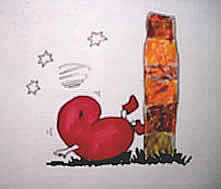
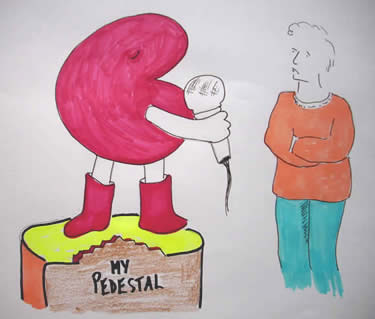
ego grabs the mike One of the major differences between people, in my experience, is whether they are willing to stop and listen, and examine their behaviour or attitudes, if I tell them directly that something they've done, or not done, has caused me upset. Turning the situation around, and speaking for myself - if I get defensive, when I bump into things (or people), if I let ego 'take care of it for me' by counter-attacking or denying responsibility, or by dismissing the feelings of others, I give ego more power over my psyche, and drain my true self of energy. When I 'stub my toe' like this, life is giving me a chance to recognise ego's activities - or my errors - same thing. If unchecked, the insensitivity to others’ feelings demanded by ego leads to ever-increasing self-betrayal and inner ruthlessness, committing the ego-ridden person ever more firmly to denial, and to twisting everything around into blaming and scapegoating others.
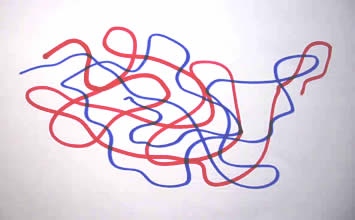
Just as criminal gangs bind new recruits to themselves by implicating them in a minor misdemeanour, one self-betrayal requires another to cover it up, so that as life goes on, there is more and more to be hushed up, denied, smothered and rewritten to divert attention and evade scrutiny. The ego-bound personality ends up tied in knots of their own devising, lost in a tangle of their own design.
My own journey into the Heartland has involved becoming more and more aware of my feelings, as they arise. This is often uncomfortable, sometimes even distressing. But it's not 'scary', as ego would have us believe, and it's certainly not more than I can cope with. It's just life, reality. Slowly growing self-acceptance has helped me learn to stand up to my internal bully (ego), and has restored me to myself – often with a smile of detached amusement. For it is a relief, really, to accept and acknowledge an error, when it's come to my attention. The best jokes are often the ones on ourselves. The encouraging thing about proceeding along this Path into the Heartland is that I feel I can do more and more about the things that disturb or unsettle me. I know now that 'it's up to me' - in the sense of 'I can DO this!' - and I am clearer about the many things that are actually not up to me to deal with, because they fall into other people's spheres of responsibility, not mine. One of my most helpful discoveries, on this Path, is that willingness engenders capacity. Just being willing to do something I don't yet see how to do has often brought the necessary ability and insight very close in its wake. |
home | intro | fear | egoland | miscellaneous | the heartland | writing reflections | psyche | culture | on the way | sentences | wordplay |
|
updated 14/1/12 |
|