|
|
Mirroring (true and false) and the Psyche
To a great extent, what I see in the world is what I unconsciously feel to be the case – psychologists call this projection. A lot of the time, I am projecting onto the world the film that runs behind my eyes, unaware that this is what I'm doing.
Writers are often dimly aware that their stories come from the unexamined regions of their minds. This makes many of them wary of psychoanalysis, for they fear that understanding where their images and story lines come from might stop their creative flow. And they might be right.
John Milton, for example, seems to have read Paradise Lost – as if it had been written on his own heart, with all its astonishing detail of motivation and physical detail.
He describes the paradise of Eden, the serpent's wiles, and the dynamics between Adam and Eve, God and Satan with the kind of intimate clarity I have only ever had about my own inner life, my own thoughts and feelings, and then only when I'm paying particular attention! It is as if Milton had found, in the story of the Fall in Genesis, an adequate myth to describe his own experience of complexity and struggle, the inside of life as he knew it. For present-day Western readers of Paradise Lost, there is a disturbing irony - because the lush and graceful perfection of ‘unfallen’ Nature Milton evokes has been so massively marred and compromised, in the intervening centuries, by the impact of our industrialising culture, here in the West and indeed all over the world.
(Danny Boyle's much-celebrated Opening Ceremony show for the Olympics shone a light on the devastating effects of industrialisation on landscape, while skipping lightly around the issues of slavery and colonialism.) Looking at the last three hundred years of our Western history in Milton's terms, it seems as if, having tasted the fruit of the forbidden Tree of Knowledge, thanks to the budding natural sciences, our hitherto Christian (Protestant), Western European society set about privatising the earth, and littering and polluting paradise with the by-products of our ever-expanding ‘knowledge’ and technological-industrial capacity.
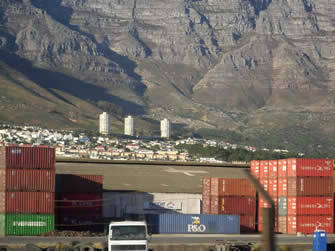
containers at Cape Town In other words, by our treatment of one another, of other creatures, and of the earth which has given birth to us, brought us into being, we seem to have made our guilt-stricken cultural myth about ‘fallen’ human nature come true. In addition, (rant warning here) -
we have deceived ourselves about the reckless and compulsive quality of our accelerating, headlong rush into the future. 'Modernising' has been used as an unthinking term of approval. We Westerners have glossed over our own distasteful and inexcusable behaviour, as we scrambled to the top of the global heap, by using respectful words to describe what we were fighting for, like ‘civilisation’, ‘progress’, 'development' and ‘growth’. We like to think that our Western history, taken as a whole, represents a kind of ethical and political triumph, a proof of our superiority over other cultures and their histories, and of our right to lead the way. Indeed, we have committed our destructive acts in the name of 'a better life', and trying to 'improve' the world as we found it.
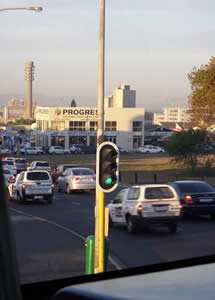
Cape Town The way we have treated the world is a big example of the ‘false’ form of mirroring – projection - whereby we recreate in the world around us an accurate reflection of the self-justifying and/or self-undermining scripts that prevail in our psyches.
We have made Milton’s moral-theological nightmare into a physical reality – not on purpose, of course, but unconsciously - because we have not looked inside ourselves, to see what’s really going on. We have evaded self-awareness. True Mirroring
|
home | intro | fear | egoland | miscellaneous | the heartland | writing reflections | psyche | culture | on the way | sentences | wordplay |
|
updated 5/1/12 |
|