|
 |
Patchwork Curtains - an Essay
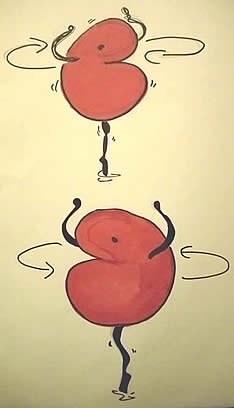
Preamble on Mental Blethers This morning I woke with a hubbub in my mind – familiar, negative stuff, going pointlessly round and round. So in my quiet time of tea and journalling, I paid attention to it, and it quickly went away. Just naming the circular, repetitive quality of these thoughts, and the feelings they were provoking in me (of being stuck, revolving on a pin, squeezed in a vice, a tight place) unmasked them for the mischievous, unnecessary nonsense they are, and - more to the point - allowed me to step away from them.
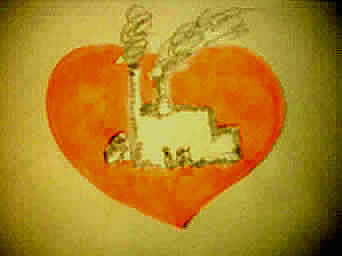
Feeling released from the pressure of this mental harrassment, it struck me that paying attention to the internal nonsense, and naming it accurately, had reconnected me with my will – I felt liberated and energised, remotivated. Feeling more like myself again, I noticed the involuntary - i.e. not-us - nature of ego-sponsored thinking. It entices us away from ourselves, sowing self-doubt and inner conflict. It is as if, when my drifting mind entertains such thoughts, I am allowing my inner space to be used as an arms factory – where the enemy being armed against is my own true self.
The mind is not meant to be full of roaring machinery, churning out the products of fear. Our inner space is meant to be neutral and open, uncluttered by anxieties and gossip, and so able to respond naturally and appropriately to events.
Free of preoccupations, the neutral mind protects us from our own and others’ nonsense. It is naturally allied with our will, and together they make an unbeatable team.
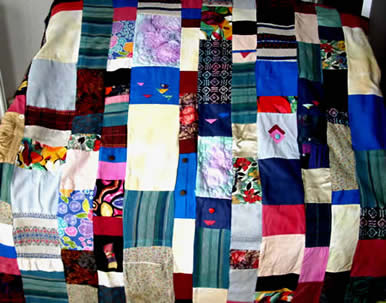
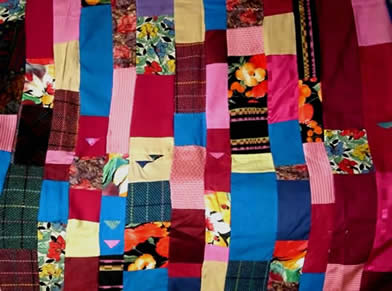
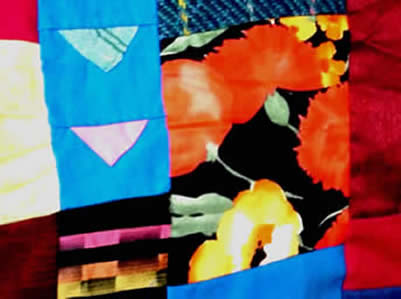
So, freed now from mental noise, I reflected on how far I’ve come from my original notions about this writing project, to get to these Rough Guides. It all began with an image of patchwork curtains. About fifteen years ago, I had finished working on my book (The Myth of Progress) and needed a brain-break. So I embarked on a huge piece of hand-sewing.
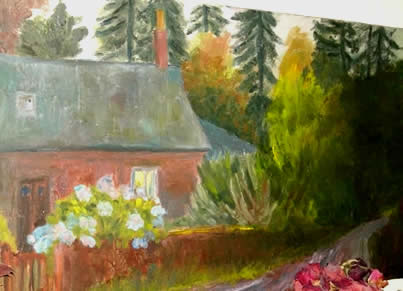
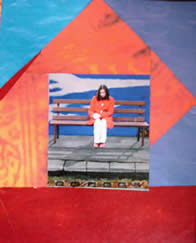
painting of the West Lodge, Pitlour, by Betty Bastai I made curtains for the wide kitchen window of the cottage I was living in, in vertical patchwork squares which gradually went from being predominantly blue to predominantly red, but in a way that was not noticeable when you focussed on any part of the whole.
This notion - and the curtains themselves - gave me a great deal of pleasure.
When I began to think about writing again, after a long gap, and knew only that I wanted to describe or explain how inner and outer life – personal and public life - are on a continuum and inseparable, these patchwork curtains came to mind. They seemed to offer an image of the way the world of events and discourse we all inhabit together grows imperceptibly out of our inner life – is the effect, or expression of it, in fact. I thought I might write chapters which would be perhaps predominantly 'red', or predominantly 'blue' – but in a way which would illustrate the interconnectedness of personal and political.
Feminism's seminal insight that the personal is political, has gradually had a profound and transformative effect on attitudes to gender in Western culture/society. I would add that the corollary to feminism's insight- that the political is personal - now needs to be taken on board. Public actions – including wars, financial catastrophes and averting them – issue from how people are in themselves, in their hearts, away from public view, and are thus able - or driven - to act and react. Over the last three or four years, my sense of what I’m writing here has evolved from being a book, or series of essays in patchwork form, with the overarching thesis of 'the political is personal', into these Rough Guides to the Heartland – a title which helps me feel my way further and further into the content of the writing without pinning me down too tightly as to form and outlets. It seems to me now that the ‘curtains’ were something to look at, as an illustration of the continuum of inner to outer, personal to political, implicit to overt – but seen still from ‘outside’, to be described as if by one observer to another.
The ‘Rough Guides to the Heartland’ framework, on the other hand, suggests a companion on a journey, a travel log (travelogue), sketchpad or journal.
My perspective has shifted to the inside, to describe how it feels rather than how it looks, and to evoke (rather than point at) the connectedness of outer and inner experience, and the primacy of inner experience. These thoughts return me to this morning’s mental nonsense, and remind me how helpful it has been to deal with it straight away, and not try to work around or 'over' it. Which leads me to think about other occasions when I find myself drifting into choppy waters -
– for example, on solitary walks, which I set out on for enjoyment and relaxation, but which sometimes lead elsewhere.
Even pottering round the house, I can drift inwardly off course - and it comes to me that the common denominator in these scenarios is the drifting – letting go of the reins.
Now I know that ‘letting go’ – of old issues and patterns, of many things – is an important skill to practise, so I was interested to notice this fear-fuelling ‘letting go’. And then it came to me that perhaps we need to let go of everything but the reins. These need to lie loosely in our hands – in our hands (not ego’s).
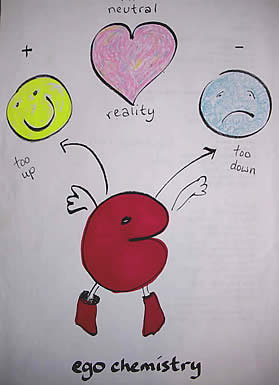
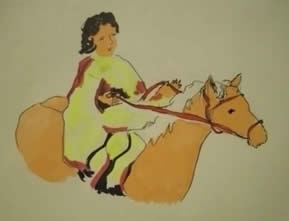
Let go, don’t let ego. One central theme of these Guides is the question of what is and is not up to us; what is, and what is not, our business to control.It is our business to pay attention to what goes on in our own minds, and to accept responsibility for the actions that issue from our attitudes.It is not our business to control, or intervene in other people's lives, on whatever pretext – though ego is endlessly inventing great-sounding pretexts for interfering, from self-vindication to rescue missions.
(Rant warning here)
The 2003 invasion of Iraq was a classic demonstration of how political events issue from how people are, at heart - and of the disastrous effects of denial, and self-deception. The distasteful manoeuvrings in the lead-up to the invasion were the expression of reversal of the correct attitude to what is and is not our business. The US/UK governments relinquished responsibility for their own attitudes and actions, glossing over their true motivations and fear-based, aggressive impulses. They devoted themselves to manipulative tactics, flagrant warmongering and truth-bending (and, of course, self-deception) which were tangible to anyone listening (really listening) to the news, for months before the war. Instead of acting responsibly and with integrity, they presumed to reach out and take control of another country – allowing fear to both goad and justify their behaviour. Fear – and all kinds of ego-driven motives - are quick to take the reins, when we let them drop. This collective abdication of correct responsibility has cost hundreds of thousands of lives, and blighted many times that number, and for how many generations? It is an old, old story, but it happens afresh to each new generation in human history - and it proceeds from inner evasions and denials. As in the political sphere, so in the personal: habitual lack of self-control - and of self-awareness - leads to the habit of trying to control others, while temporary loss of self-control can lead to panicky efforts to control someone else. When we are attending to our own mental contents, we have no need to manipulate, intimidate, or encroach on others. All this is of course much easier said than done - and the hardest thing of all is to notice when we ourselves are up to our old tricks! Spotting Ego in Our Own MindsIf we allow ego the floor, it whispers to us that it is telling us things we need to know, and that our wellbeing (when it’s not around) is based in self-deception. This is ego-reversal: the truth is spun around 180%, so that something true (when it's the right way round) is put into the service of untruth, and used to undermine wellbeing.
Thinking about this ego-tactic this morning, and wondering how I could know where the truth lies, I realised that when I am at rest and in balance, I am shown the things I need to see – even things I may have avoided seeing before, without any sense of being diminished or shamed. Gnawing self-doubt is not part of genuine learning – it shuts us down, emotionally, confuses us, estranges us from ourselves. So the proof of ego's threatening presence is in our churning stomachs, or a hollow feeling in the chest. There is no dismay in the Heartland, because everything belongs, and plays its part. The open heart is shown the way without finger-pointing or accusation.
This brings me back to my writing journey of the past few years, from the patchwork curtains to these Rough Guides. The direction of this journey has been ‘in the way’. Letting myself fall ‘in the way’, I have been freed from inner pressures, including anxieties about being heard, and have been reunited with my will. I feel the transformation directly, as energy, motivation – an inner smile. Likewise, I can feel when my wellbeing slips away again, and I know it’s time to pay attention, take care, and notice what’s going on.
|
home | intro | fear | egoland | miscellaneous | the heartland | writing reflections | psyche | culture | on the way | sentences | wordplay |
|
updated 19/2/12 |
|